A superb Blue Flag beach serving the resort of Albir on the northern Costa Blanca, Playa Raco de L’Abir is mostly composed of small pebbles though not to the point of being a discomfort, being mostly smooth and easy on the feet. An extremely popular beach especially during the busy summer months, Albir beach has some fine facilities, much as you would expect from a busy tourist resort. For those who forget to bring, or don’t have sun loungers and umbrellas, there are a good selection available for hire on the beach at reasonable rates, and these are well worth investing in. For the kids there are pedalos for hire, and for the more energetic there are also water sports facilties, including water skiing, para-sailing and windsurfing, you can also have a go on the banana boat or the doughnut. Most visitors will prefer to simply bask in the sunny weather and top up their tans. For the safety of swimmers there is generally a lifeguard on duty during the busiest hours and swimmers should watch out for the flags which inform of the latest conditions, do not swim if a red flag is flying. All in all a great beach, in a lovely resort which is located just off the N-332 only six kilometres from the busy resort of Benidorm and three kilometres from Altea. Albir Map.
March 25, 2010
March 24, 2010
Cabo Roig Orihuela Costa
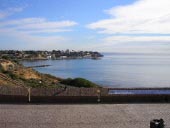
Cabo Roig Bay and Marina
One of the most popular holiday destinations along Spain’s southern Costa Blanca coastline, Cabo Roig is a beautiful and desirable resort. Renowned for its clean sandy beaches, its lovely marina and its excellent strip of bars, shops and restaurants, Cabo Roig offers everything you would want for a great family holiday. Though it is very busy during the summer months it is actually a superb location for a holiday any time of the year. Easy to reach from both Alicante and Murcia airports, Cabo Roig is handily placed for visiting other attractions along the Costa Blanca and Costa Calida.
The eye-catching 16th century watchtower, around which Cabo Roig originally grew, is now part of a restaurant complex which overlooks the recently modernised marina. An estimated 2 million euros was spent on the refurbishment of what is now one of the Costa Blanca’s most desirable mooring spots.
There are a number of excellent beaches to visit whilst on a trip to Cabo Roig. The main beaches are Cala Caleta and Cala Capitan both very popular with holidaymakers. Also within easy reach are the beaches at Campoamor, La Zenia and Playa Flamenca. All of these beaches are kept very clean and are usually raked every day, they are also safe for children.
Cabo Roig, along with the entire Costa Blanca region, has a wonderful climate and the sun shines on over three hundred days per year, the mean temperature being about 20 degrees C. You can usually expect to see little rainfall between May and October and the days are generally long and sunny. When rain does fall it is usually during the winter months, November and February being the most common months for rain. December and January are usually sunny and pleasant but with cold nights.
There is plenty to do in and around Cabo Roig, why not start with a trip into the nearby town of Torrevieja, with it’s wonderful promenade and marina and it’s many fine beaches? If you are visiting during the summer months, don’t forget the Aqua Splash park with its gigantic slides, refreshing pools and excellent picnic area. If you feel a little more adventurous you may wish to try out the go-karts at Punta Prima, here you can drive the full size karts or the kids can have a go on the mini karts or even the mini quads. In the summer the circus comes to town and this is a great attraction for the children and adults alike, being an old style circus, it has plenty of animals performing tricks to amaze and entertain. The younger at heart may prefer a trip to the busy resort of Benidorm, a journey of around an hour and a half (a coach picks up in Cabo Roig a couple of times a week), Benidorm has some wonderful facilities including Aqualandia, Terra Mitica and the Mundomar Marine Animal Park. Sporting enthusiasts may partake of the golfing, the water sports (the water sport resort of La Manga is only a 40 minute trip), or the fishing – there are angling safaris available for those preferring fresh water angling.
If you are looking to buy a property on the Costa Blanca, then Cabo Roig would be an ideal location, with plenty of variety ranging from 1 bedroom apartments to beautiful detached villas on the seafront.
Cabo Roig is easily reached by way of the N-332 coastal road (Cartagena to Alicante) or from the AP-7 motorway junctions 768 or 763. The closest airport is Murcia (San Javier) which is approximately 20 minutes drive away. Benidorm is located further north but can also be easily accessed from the N332.
March 21, 2010
Benidorm Costa Blanca
Sea, sun, sand and sangria – the Spanish resort of Benidorm certainly offers all of these and plenty more besides. Situated in the Costa Blanca region of south-eastern Spain, Benidorm is, these days, the major destination in Europe for tourists looking for a seaside holiday, with in excess of four million visitors per year, this is a serious resort, the fabulous warm Benidorm weather attracting more and more visitors every year. Most visitors today would find it hard to believe that
Benidorm was just a tiny fishing village up until the 1950’s when a growing tourist industry would result in huge changes not just to Benidorm but also many other towns and villages throughout Spain. The history of Benidorm, of course, goes back much, much further, with evidence of settlements as long ago as 3000 BC.
Fragments of Punic and Roman ships have been discovered in the Bay of Benidorm and there are also remains of a Roman villa in the area. However, the recorded history of Benidorm starts during the Moorish Conquest, when the first genuine settlement was built by the Moors and Benidorm became a fishing community of some significance. Benidorm and the region was reconquered for the Christians by Jaime I of Aragon (Jaume I) in 1245 and in 1325 the town was awarded its first charter. The original Benidorm Castle was built at around this time and was constructed in the area of the old village. Although no evidence now remains of the castle it was, at the time, very important in defending Benidorm from frequent attacks by Barbary pirates.
An irrigation drain built in 1666 to supply water to the surrounding land brought some improvements to the area and by 1715 the population of Benidorm had risen to 216. 1740 saw the start of construction on the Parish Church of San Jaime and the population grew rapidly by 1794 had topped 2,700. Although agriculture contributed to Benidorm’s economic survival during these years, fishing remained the prime industry and Benidorm’s fishermen gained a reputation as tuna fishermen.
By 1857 the population had risen to 3,750 but dropped back once again in 1920 when an outbreak of phylloxera seriously damaged a thriving grape growing industry. At around the same time there were signs of an emerging tourism industry in the area aided by the building of a narrow gauge railway. A small but growing number of tourists headed for Benidorm from inland towns such as Madrid.
Disaster loomed for Benidorm in the early 1950’s as fish catches fell dramatically, however an increase in tourism and a plan drawn up by the town in 1956 for improvements in the town targeted at leisure and tourism, was well founded, it resulted in a huge growth in population, which further accelerated in 1967 on the opening of Alicante (El Altet) airport.
Modern day Benidorm is a successful holiday resort with numerous hotels and rental accommodation properties catering for holidaymakers of all ages, nationalities and tastes. There is lots to see and do in and around Benidorm, there are 2 superb beaches (Playa levante and Playa Poinente), some wonderful theme parks such as Terra Mitica, the Aqualandia Water Park and Mundomar Marine and Exotic Animal Park, whatever you are looking for Benidorm certainly delivers. Benidorm Map.
March 13, 2010
Lagos Algarve Portugal
One of the busiest tourist centres on Portugal’s Algarve coastline, Lagos was in fact one the capital of the region and its harbour welcomed in the great Henry the Navigator as he returned from his historic voyages. The ancient fortress and sections of the old city walls survived the devastating Lisbon earthquake of 1755, as did a couple of its churches. In the old town, you will still find narrow, cobbled streets, which look much as they have for centuries. To view the best of the town’s attractions head for the Praça da Republica, the centre of life in Lagos. Modern day Lagos is a bustling holiday resort, popular with the younger set, it offers a superb sandy beach, plenty of bars, shops and restaurants, a good choice of facilities and a wonderful climate, with Lagos weather ideal for summer holidays and also suitable for winter breaks and sporting holidays. Lagos is at the western end of the Algarve, near to Portimao, and provides a good base for exploring this part of the region, other towns worth a visit include Sagres and Portimao.
Map.
Malgrat de Mar Catalonia
One of the popular coastal resorts of the southern Costa Brava, Malgrat de Mar is actually situated on a stretch of coast known as the Costa del Maresme. The town has a resident population of around 20,000 and a municipal district of 9.05 square kilometres. The modern resort is well known for its excellent sandy beaches (such as L’Astillero) which are backed by hotels and apartment complexes, there are a good choice of bars and restaurants which become very busy during the summer season when the climate is fine and sunny. The original village developed during the 13th and 14th centuries when it was known Vilanova de Palafolls, the original dwellings were erected on a hill called “Es Castell”, for many centuries Malgrat de Mar relied on fishing for its economic survival and this continued until the 1950’s and 1960’s when the explosion of tourism changed the face of the town forever, and the population grew from under 4,000 to its present level. In the old town there are still some well preserved older buildings showing evidence of its long history, the 16th century church of Sant Nicolau is often referred to as the “Cathedral of the Coast” due to its large size. Malgrat de Mar is located between Blanes and Pineda de Mar and can be reached from the N-11 or the C-32 motorway.
Map.
Letchworth, Hitchin and Baldock Hertfordshire
Three of the larger towns in the county of Hertfordshire, England, Letchworth, Hitchin and Baldock could not be more different. Letchworth formerly just a small village, was joined with the villages of Norton and Willan to form Letchworth Garden City, one of Ebenezer Howard’s ‘new towns’ in 1903. Set out as part of his dream of a city surrounded by countryside, with every house having its own garden, Letchworth never quite lived up to Howard’s ideals. On the other side of the historic coin, Hitchin was a settlement of the Hicci tribe way back in the 7th century, its name seems to have derived from the local River Hiz (pronounced Hitch). The town later prospered due to the wool trade and was a staging post for coaches travelling north from London. Local legend tells that Henry VIII almost died in a fire in Hitchin, though he managed to escape across the aforementioned River Hiz. Not quite so old, but historic nonetheless, Baldock was founded by the Knights Templar during the 12th century, the town grew around the crossroads of the Icknield Way and the Great North Road, and, like Hitchin, became a coaching post for travellers to and from London. Baldock developed since the 16th century as an important brewing and malting centre, with three major breweries operating in the town, which was also renowned for its large number of pubs!