Archive for the ‘Algarve’ Category

Lagos Algarve Portugal

Saturday, March 13th, 2010

One of the busiest tourist centres on Portugal’s Algarve coastline, Lagos was in fact one the capital of the region and its harbour welcomed in the great Henry the Navigator as he returned from his historic voyages. The ancient fortress and sections of the old city walls survived the devastating Lisbon earthquake of 1755, as did a couple of its churches. In the old town, you will still find narrow, cobbled streets, which look much as they have for centuries. To view the best of the town’s attractions head for the Praça da Republica, the centre of life in Lagos. Modern day Lagos is a bustling holiday resort, popular with the younger set, it offers a superb sandy beach, plenty of bars, shops and restaurants, a good choice of facilities and a wonderful climate, with Lagos weather ideal for summer holidays and also suitable for winter breaks and sporting holidays. Lagos is at the western end of the Algarve, near to Portimao, and provides a good base for exploring this part of the region, other towns worth a visit include Sagres and Portimao.

Map.

Huelva Costa de la Luz

Friday, March 12th, 2010

The most westerly city on the Costa de la Luz, Spain, Huelva was founded by the Phoenicians in around 1000 BC. Originally known as Onoba, Huelva was later controlled by the Romans and became part of the province of Hispania Baetica, the Romans established a mint there and coins were produced bearing the name “Onuba”. In the 15th century the explorer Christopher Columbus sailed from nearby Palos de la Frontera, and the discovery of the Americas brought increased wealth to Huelva, though it was generally overshadowed by the more important city of Seville. Significant mineral deposits in the region led to Huelva becoming the home of the well known Rio Tinto Company, a British mining concern which set up shop in the Odiel estuary and subsequently exported its products throughout the civilised world. Huelva fell into decline after being devastated by the great Lisbon earthquake of 1755, though it has always been a significant port for the region. Located on a stretch of coast known as the Costa de la Luz (Coast of Light), Huelva is experiencing an increase in tourist activity as this less well known piece of coast attracts more and more visitors to its virgin beaches, as yet untouched by mass development. Enjoying a wonderful climate with Huelva weather being somewhat cooler than the neighbouring Costa del Sol, enjoying cooling Atlantic breezes and having a similar climate to Portugal’s Algarve to the south-west. Huelva is located just off the A-45 motoway between the Portuguese border and the city of Seville. Map.

Isla Canela Costa de la Luz

Thursday, March 11th, 2010

Just south of Ayamonte on the border between the Costa de la Luz in south-western Spain and the Algarve Portugal, the relatively new resort of Isla Canela is joined to the Spanish mainland only by a causeway which links it to the town of Ayamonte. Long popular with Spanish tourists, Isla Canela boasts over seven kilometres of superb beaches, an 18 hole golf course, and some wonderful protected wetlands which are home to a wide variety of bird species. Isla Canela looks across the River Guadiana to Portugal and shares a similar climate to the resorts of the Algarve, with Isla Canela weather being perfect for summer holidays though cooler than the Costa del Sol to the north-east. A great area for water sports, this coast gets plenty of wind from the Atlantic Ocean and is good for windsurfing and similar sports. Don’t expect a bustling resort or a vibrant nightlife scene whilst visiting but do expect a peaceful holiday with plenty of time to relax. Isla Canela Map.

Vilamoura Algarve Portugal

Saturday, February 20th, 2010

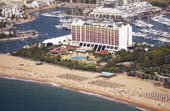
One of Europe’s largest beach resorts, Vilamoura on the Algarve, Portugal, is a built for tourism complex some 14 miles west of Faro. Covering an area of around 20 square kilometres, Vilamoura is built around its huge marina, where there are moorings for over 1,000 boats and numerous large luxury hotels for accommodation in the resort. The development of Vilamoura began in the 1970’s, with an emphasis on sports facilities, very popular with golfers, there are 6 golf courses in the immediate area. Water sports too, are a big attraction with sailing, scuba diving, windsurfing, water-skiing, fishing and parasailing all well catered for. The wonderful Vilamoura weather is of course one of the main attractions of the resort, as is the fine sandy beach which extends for some three kilometres, those looking for a bit of culture may want to head north of Vilamoura beach, where some Roman remains remind visitors of the areas rich history. Vilamoura Map.

The Algarve Region of Portugal

Sunday, February 14th, 2010

The beautiful region of Algarve in southern Portugal is one of Europe’s most popular holiday destinations and rightly so as it a stunning area of coastline with some fine resorts. The capital of the Algarve region is Faro, and it is here that you will find the main airport for the region, once a fishing port and trading centre called Ossonoba. If you are arriving for your visit to the area by air, you will no doubt be arriving at Faro Airport and this is the best place to pick up a car hire vehicle for your stay. To the west of Faro is the resort town of Albufeira, dating from Roman times it still has some remains from these ancient times, in recent years it has grown considerably and is now one of the regions most visited resorts. Another resort experiencing rapid growth is Quarteria, formerly a small fishing village, it is now a bustling resort with a fine beach and a very long promenade. While prices in the area have risen with its popularity it is still possible to pick up some bargains and suitable products are leather goods, pottery and decorated tiles. The Algarve experiences a splendid climate with some of the best weather in Portugal, summers are hot and winters mild, rainfall is mostly experienced during the winter months. Other places that you might choose to visit whilst in the region include Portimao, Lagos, Sagres, Praia da Rocha, Carvoeiro, Tavira and Luz. You can view a map of the country here, the Algarve region is in the far south. Portugal Map.

Praia da Rocha Portugal

Friday, January 22nd, 2010

One of the best known and earliest established beach resorts on the Algarve coastline of southern Portugal, Praia da Rocha has attracted large numbers of holidaymakers since at least the 1930’s. Undergoing significant developed since those early times, Praia da Rocha draws an ever increasing multitude of visitors who arrive to delight in the superb beach, the bustling nightlife and the wonderful  weather that the resort enjoys. No doubt the main attraction of all of these is the fantastic golden, sandy beach, which lies beside the attractive red sandstone cliffs another notable feature of the resort, the cliffs are formed into numerous weird shaped rock formations, some interesting subjects for a photo or two. The ancient city of Portimao is just a short drive or a good walk away (about a mile and a quarter), Portimao is a busy port and the 2nd largest city in the Algarve region of Portugal. You can view a map of the Praia da Rocha area here: Praia da Rocha Map.

Lagos Portugal

Friday, January 22nd, 2010

One of the highlights of the Algarve region of Portugal is the historic town of Lagos, former headquarters of the famous explorer Henry the Navigator. Crammed with historic buildings despite being severely damaged in the great earthquake of 1755, Lagos has some of its old city walls, a 17th century castle and many interesting post earthquake buildings and monuments. Also a well known area for surfing, this part of the Algarve coast is windswept and battered by the Atlantic Ocean, with numerous prime locations between Lagos and Sagres in the extreme west. For beach lovers, Lagos is perfect as there are lots of wonderful beaches in the area and some charming little seaside resorts nearby, this is of course as well as the delightful Lagos weather which alone attracts many visitors. Despite this, the old town is the main draw, best explored by foot, visitors can wander the narrow winding streets taking in the atmosphere and imagining what the place was like when Portugal was a major seafaring nation. The port area dates from Roman times and was at that time called Lacobriga, it would have been a major trading town, servicing ships going along this busy coast. Later controlled by the Moors, it came back into Christian hands in 1241 and enjoyed the boom created by Portugal’s growing Empire in Africa and South America. Present day Lagos has a population of around 18,000 most of which is concentrated near to the coast, the main industry is tourism. Lagos is around 65 kilometres from Faro and its airport so you may need to hire a car should you wish to visit. Lagos Map.

Faro Algarve Portugal

Sunday, September 6th, 2009

Offering an interesting mix of architecture, Faro on the Algarve, Portugal, is a worthwhile place to visit. Much of the old town was destroyed by the great earthquake of 1755 but some old buildings and much of the old city walls survived and can still be seen today. The Acro da Vila post earthquake entrance welcomes you to the old town, sporting its statue of St Thomas Aquinas, narrow cobbled streets lead to the main square where the old Cathedral sits, originally built in the 13th century, it is though to have occupied the site of a former Arabic mosque, and previous to that probably a Roman temple. Much of the existing building was reconstructed after the earthquake. Beside the Cathedral you can see the Convento de Nossa Senhora da Assuncao which dates from the 16th century and houses the Municipal Museum, also in the main square of Faro is the 18th century Bishop’s Palace. Visitors can exit the square by way of the Arco de Repousa (Gate of Rest) and head out towards the Ferry Pier from the pier you can take a boat trip to Praia de Faro beach and relax after your busy day. Other interesting museums in Faro include the Museu Maritimo and the Museu Regional do Algarve. For those wishing to visit this historic place, Faro Airport is situated about 2.6 kilometres to the west of the city centre, it receives mostly tourists heading for the Algarve region and also for the south of Andalucia in Spain. Faro Map.

Carvoeiro Portugal

Monday, August 31st, 2009

If you are looking for a decent family resort for visiting the Algarve region of Portugal, you could do little better than the former fishing village of Carvoeiro, situated between Portimao and Albufeira. A charming little town with an emphasis on self-catering apartments, Carvoeiro has a friendly feel and boasts a fine sandy beach, attractive coastline and some decent facilities. A good base for touring some of the historic towns in this section of the Algarve, the town enjoys a super climate with Carvoeiro weather, sunny and warm throughout the summer months, and mild during the winter. One of the highlights of a trip to Carvoeiro is a boat trip to Algar Seco, a local beauty spot where cliffs have been moulded by the sea into stone arches, grottoes and fascinating shapes. Carvoeiro Map.

Andalucian Towns – Ayamonte

Wednesday, August 19th, 2009

Standing on the Guadiana River on the border between Spain and Portugal, the charming little town of Ayamonte has an attractive fishing harbour and an atmospheric ‘old quarter’. Not as important as it once was, since the building of a new suspension bridge to the north, Ayamonte still attracts plenty of tourists and still has a ferry link with the town of Vila Real de San Antonio, on the other side of the Guadiana River in Portugal’s Algarve region. Ayamonte itself has some interesting attractions including the Iglesia de San Francisco (16th century) and the Iglesia de San Salvador (15th century). Those seeking a more traditional beach holiday will head for nearby Isla Canela, with many kilometres of wonderful sandy beaches and an excellent golf course, Golf Isla Canela, visitors can enjoy a fine climate with Ayamonte weather being comparable to the nearby Algarve. Isla Canela is accessed by way of a causeway from Ayamonte as it is actually an island separated from the mainland. Surrounding wetland areas are great for birdwatching and they are now a protected nature reserve. Ayamonte Map.