Continuing my series of local business websites for the Aylesbury area of Buckinghamshire, United Kingdom, I have just done a new site for an Aylesbury hairdresser, which should be handy for those seeking hairdressing and beauty services in the Aylesbury area. These local business websites are fairly easy to get decently ranked, and certainly bring in some business for those who choose to do them. The website is not finished yet and is pretty basic, but at the end of the day it is the rankings which matter, so I will be watching it closely over the next few months to see how it progresses. I shall be adding lots more Aylesbury business websites shortly as it is part of an experiment that I am trying out..
November 25, 2010
March 3, 2010
Waddesdon Manor Buckinghamshire
One of Buckinghamshire’s most visited tourist attractions Waddesdon Manor is situated in the village of Waddesdon, to the west of the county town of Aylesbury. Constructed in the Renaissance style for the Rothschild family, Waddesdon Manor receives over 300,000 visitors each year, and the house hold numerous functions and events including weddings, shows ie The Antiques Roadshow, and it has been the location of a number of film shoots. Open all year round, perhaps the best time to visit is during the spring and summer when the wonderful gardens are at their best and the weather is most reliable. Waddesdon Manor was designed by Frenchman Destailleur and was completed in 1874, having the appearance of a French Renaissance chateux, it was the brainchild of Baron Ferdinand de Rothschild, part of the wealthy family who own much of the land surrounding the villages of Waddesdon and Eythrope.
Read a guide to Waddesdon here: http://www.waddesdon.my-towns.co.uk/
Comments Off on Waddesdon Manor Buckinghamshire
January 15, 2010
Aston Clinton Buckinghamshire
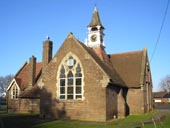
Aston Clinton Parish Church
A small village located to the east of Aylesbury in the county of Buckinghamshire, England, United Kingdom, Aston Clinton has a population of 3,000 and has been a settlement since at least Saxon times and possibly earlier (a Roman cemetery has been found nearby). It was important enough to be mentioned in the Domesday Book, where it was names as Estone. The construction of it’s parish church begun during the twelfth century and later work was done subsequently with a full restoration in 1867. It became the home of Sir Anthony de Rothschild during the 19th century and it was Sir Anthony who gave the Aston Hall to the village for use as a school. Aston Clinton is notable as having given it’s name to the Aston Martin car after one of the founders of the company entered a hill climbing trial on Aston Hill. Modern day Aston Clinton is a charming little village and a desirable location to live with easy access to the busy town of Aylesbury.
Comments Off on Aston Clinton Buckinghamshire
August 14, 2009
The Buckinghamshire Town of Winslow
Situated in the Aylesbury Vale district of Bucks (Buckinghamshire), the market town of Winslow has a long history, with settlements as far back as Anglo-Saxon times. Also recorded in the Domesday Book, Winslow these days has a population of between 4,000 and 5,000 and remains a charming little market town with a typical English village feel. Winslow Hall is said to have been designed by Sir Christopher Wren in around 1700, and even older is its parish church of St Laurence which dates from the eleventh century. The famous Whaddon Chase fox hunt, traditionally meets on Boxing Day in Winslow town square, an event which attracts many onlookers. Winslow is situated on the A413 between Buckingham and Aylesbury. Winslow Map.
Comments Off on The Buckinghamshire Town of Winslow
July 27, 2009
Buckinghamshire
A beautiful rural county to the north-west of London, Buckinghamshire is one of the traditional ‘Home Counties’ of south-eastern England. The county town of Buckinghamshire (normally just referred to as Bucks) is Aylesbury, situated fairly centrally within the county. Aylesbury however was not always the county town, this honour fell to Buckingham itself, which gave Buckinghamshire its name and was the primary town from 888 until replaced by Aylesbury during the 16th century. The name of the town and the county derives from that of a wealthy landowner named Bucca, and literally means “Bucca’s Home”. Buckinghamshire was originally a sub-division of the Kingdom of Mercia between the 6th and 12th centuries, though there were of course settlers here long before this, with many Roman remains being found throughout the region, for instance in High Wycombe where there was a Roman Villa in the 2nd century AD. The county features a mix of historic and modern towns, the most modern being the huge city of Milton Keynes, which is now a unitary authority separate from the control of Bucks County Council. Milton Keynes was originally just a small village, and the name was taken by the new town (so declared in 1967) which swallowed a number of towns and villages in the area such as Bletchley, Wolverton, Stoney Stratford and Newport Pagnell. The south of the county has some very affluent towns, many of which have become commuter towns for those working in London. In the extreme south, Marlow sits attractively on the banks of the River Thames, and is a popular tourist spot as well as a pretty town, barely spoilt by development, historically it was mentioned in the Domesday Book, and was later given by William the Conqueror to his Queen Mathilda. Other affluent towns in this part of Buckinghamshire include Beaconsfield, Amersham and Chesham. Beaconsfield is very pretty, and during the times of Queen Victoria became notable as the seat of PM Benjamin Disraeli. Beaconsfield sits close to the M40 motorway, making it a desirable though expensive commuter town. Beaconsfield is also notable as the burial place of some famous people including G K Chesterton and poet Edmund Waller. Amersham and Chesham sit together to the north of Beaconsfield, both are attractive towns with perhaps Amersham taking the edge, especially the area of the Old Town which has changed little over the centuries. Amersham has two separate areas the Old Town and Amersham on the Hill (locally called Top Amersham) where the railway station is situated. Both Chesham and Amersham are joined to Central London by the underground network, making them very popular with commuters. Chesham is situated in the Chess Valley and has had human settlement since 8,000 BC, historically it was known for its religious unrest and saw a number of burnings in the 16th century including that of Thomas Harding for being a heretic and a Lollard. Overall Bucks is a pretty rural county with few large towns and only one city (Milton Keynes) it comprises mostly small, pretty villages and attractive market towns, the rolling, green Chiltern Hills add to the attraction.
Visit a dedicated Aylesbury website here: http://www.my-aylesbury.co.uk
View a map of Buckinghamshire here: http://www.my-towns.co.uk/buckinghamshire-map.html
More maps here: http://www.buckinghamshire-maps.co.uk
Comments Off on Buckinghamshire